Make AI Answers Your New Growth Channel











Discovery is moving from search to AI Answers
Shoppers are asking AI what to buy, which brands to trust and which products to compare. As product discovery moves from search results to AI answers, brands need to understand where they show up, where competitors appear instead and what it takes to be recommended.
Are Your Brand And Products Part Of The Answer?
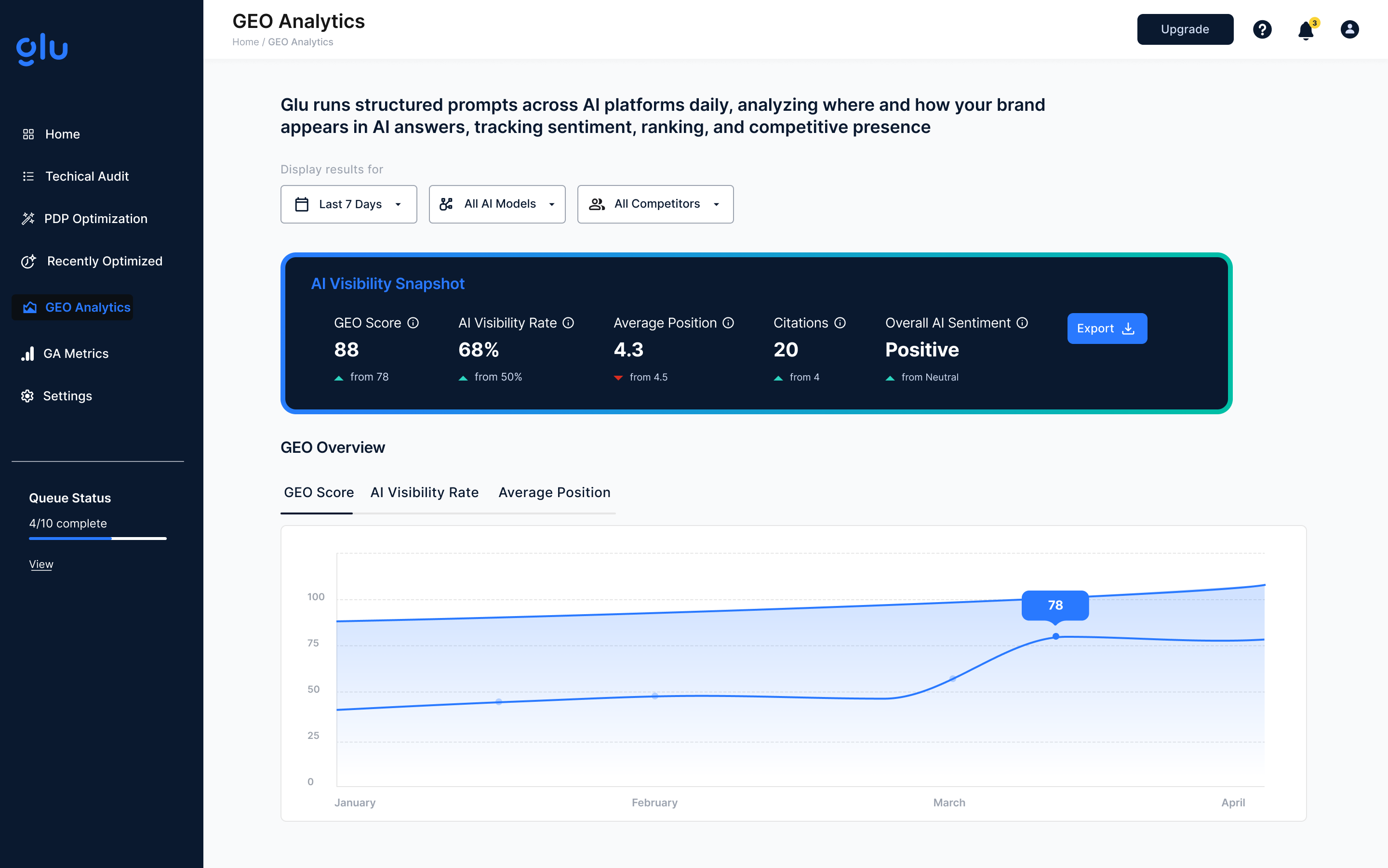
Every high-intent prompt creates a new consideration set. Glu shows whether your brand is visible, where competitors are winning, and what needs to improve.
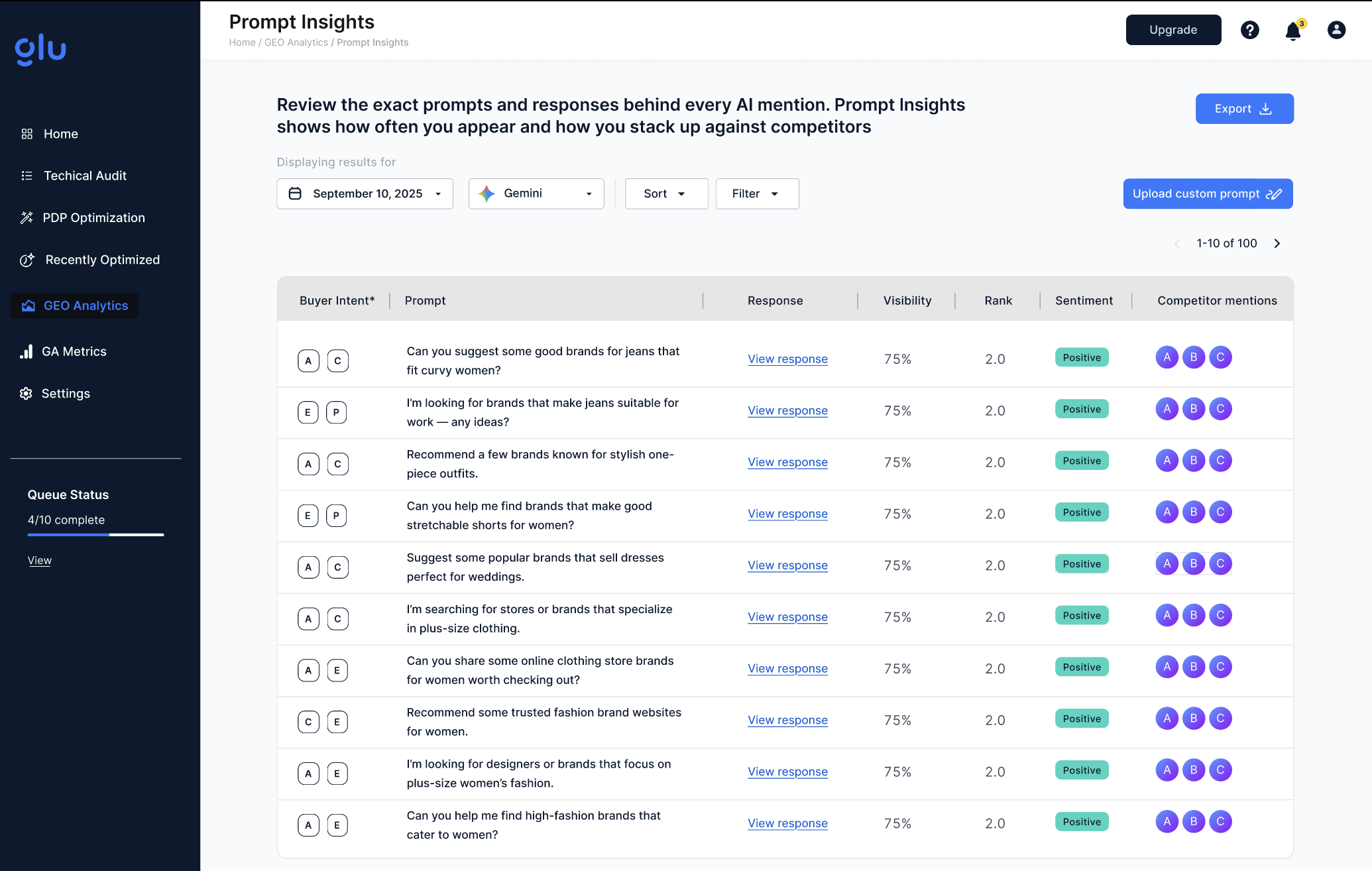
Know Where You Stand
Track how your brand performs across prompts, platforms and market.

Your AI Visibility

Your Competitive Gaps

Continuous updates
Trusted by brands building for the future of commerce.
.svg)
1
4
9
7
3
26X
1
4
7
9
3
23%
.svg)


1
4
7
9
3
18%
One Platform To Turn AI Visibility Into Action And Growth.
Most AI visibility tools show you where you stand. We help you understand what is driving it and what to change next.
See where your brand appears in AI answers.

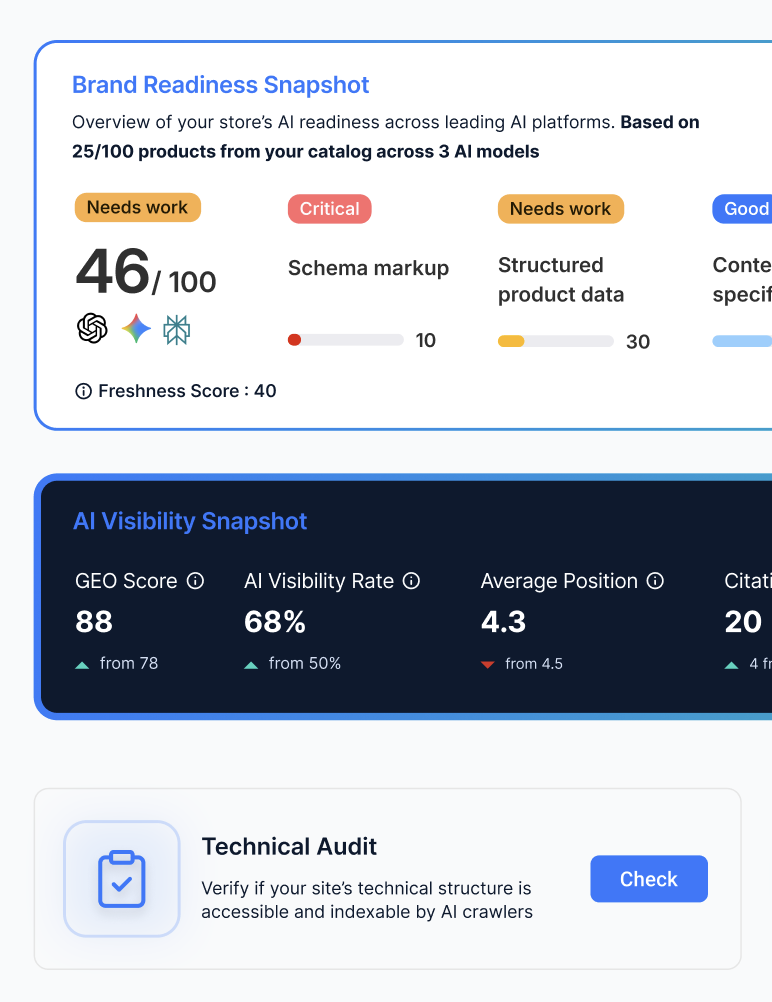
Understand why competitors show up instead.
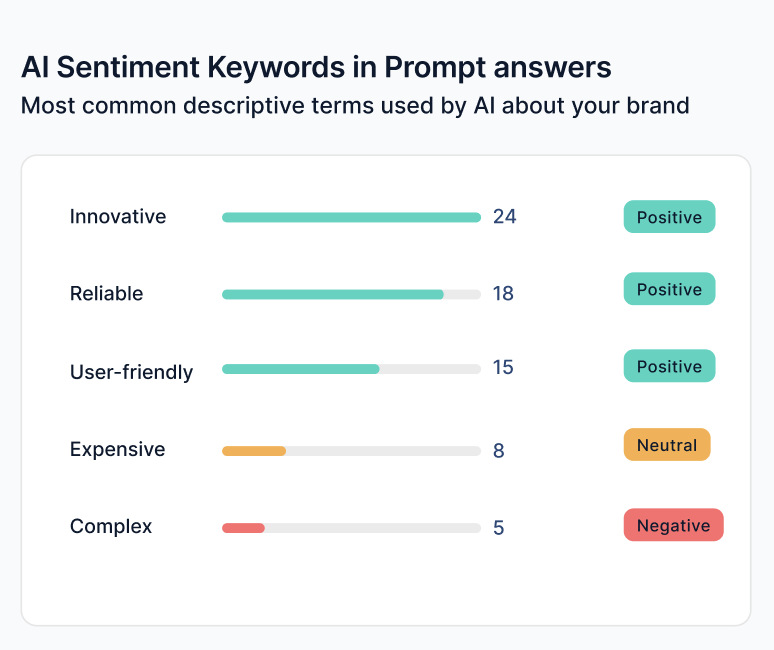
Focus on the gaps that matter most.
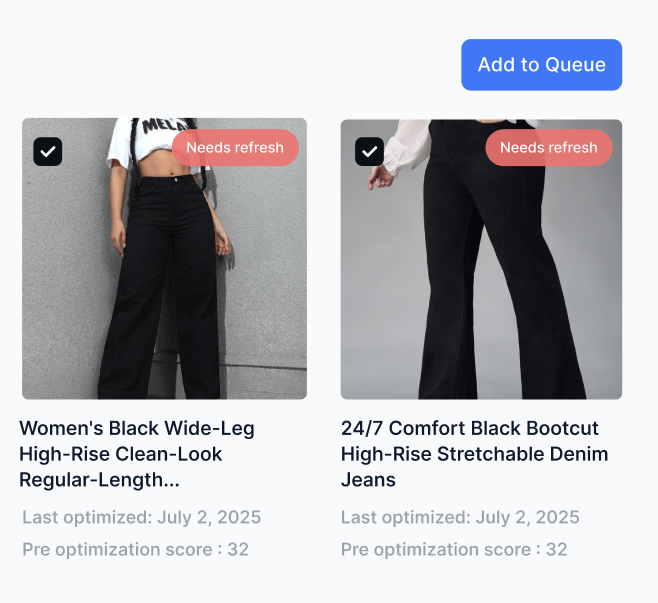
Improve the signals AI relies on.
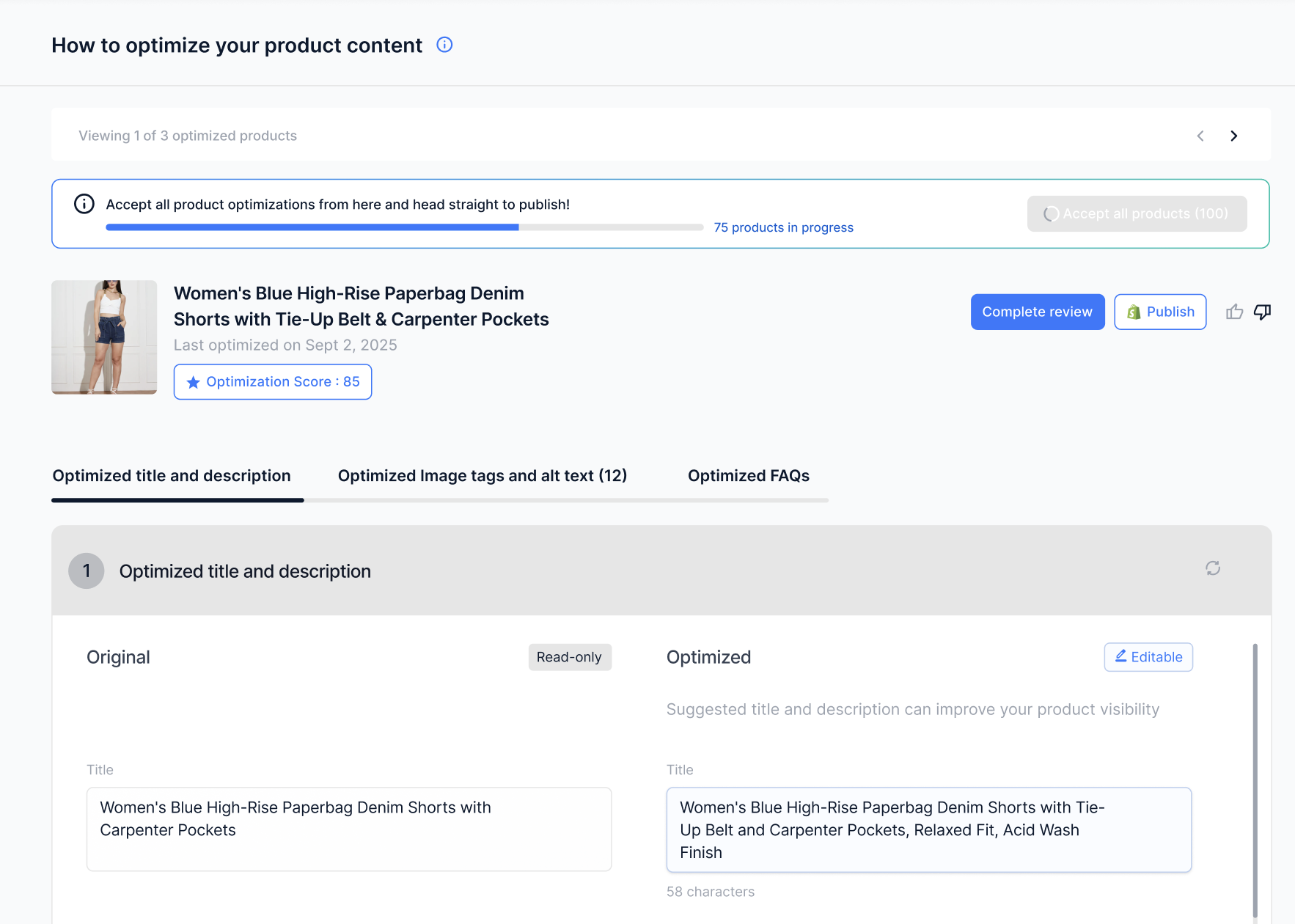
Track progress as your AI visibility improves.
Build An AI-Eligible Catalog At Scale
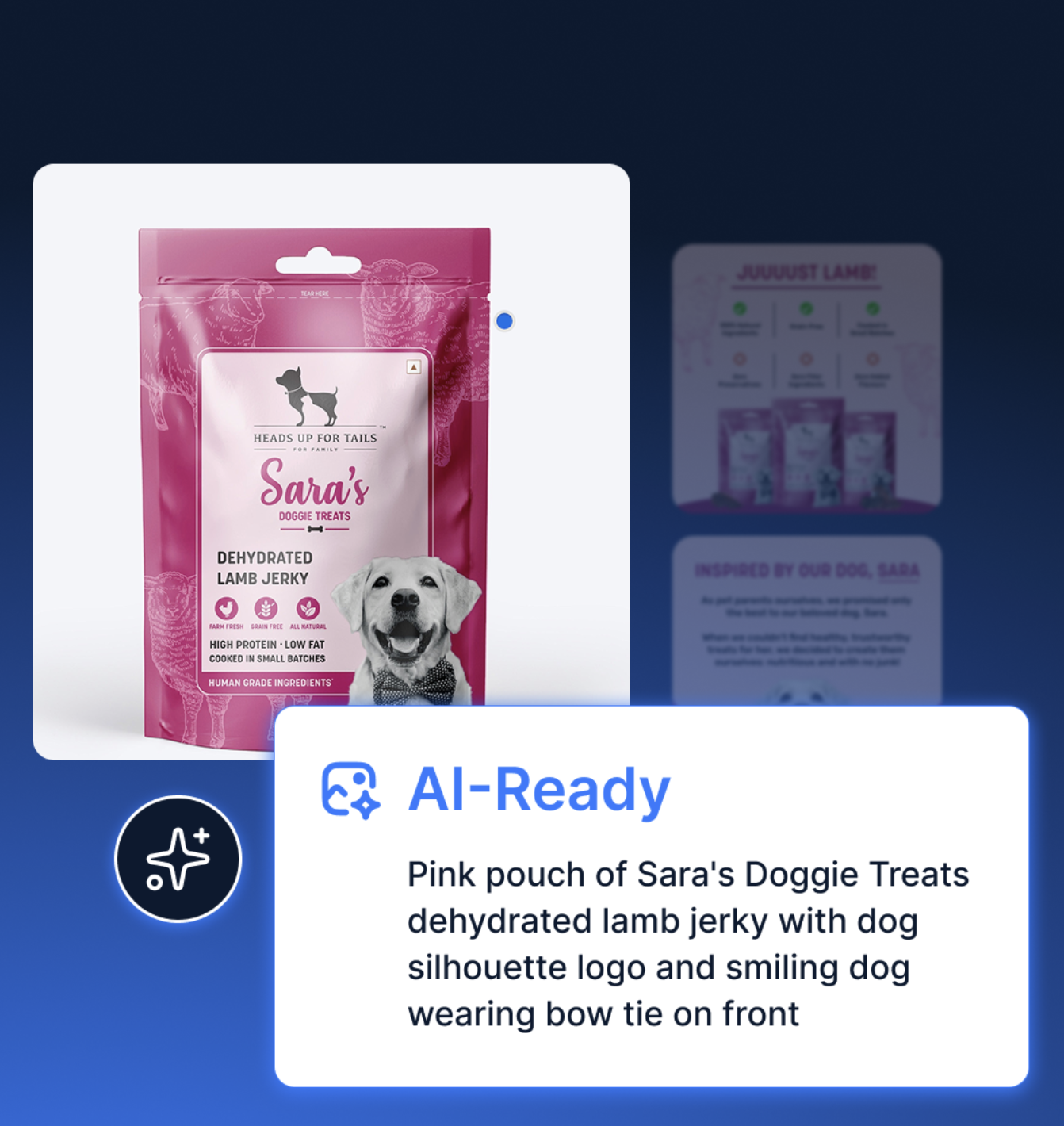
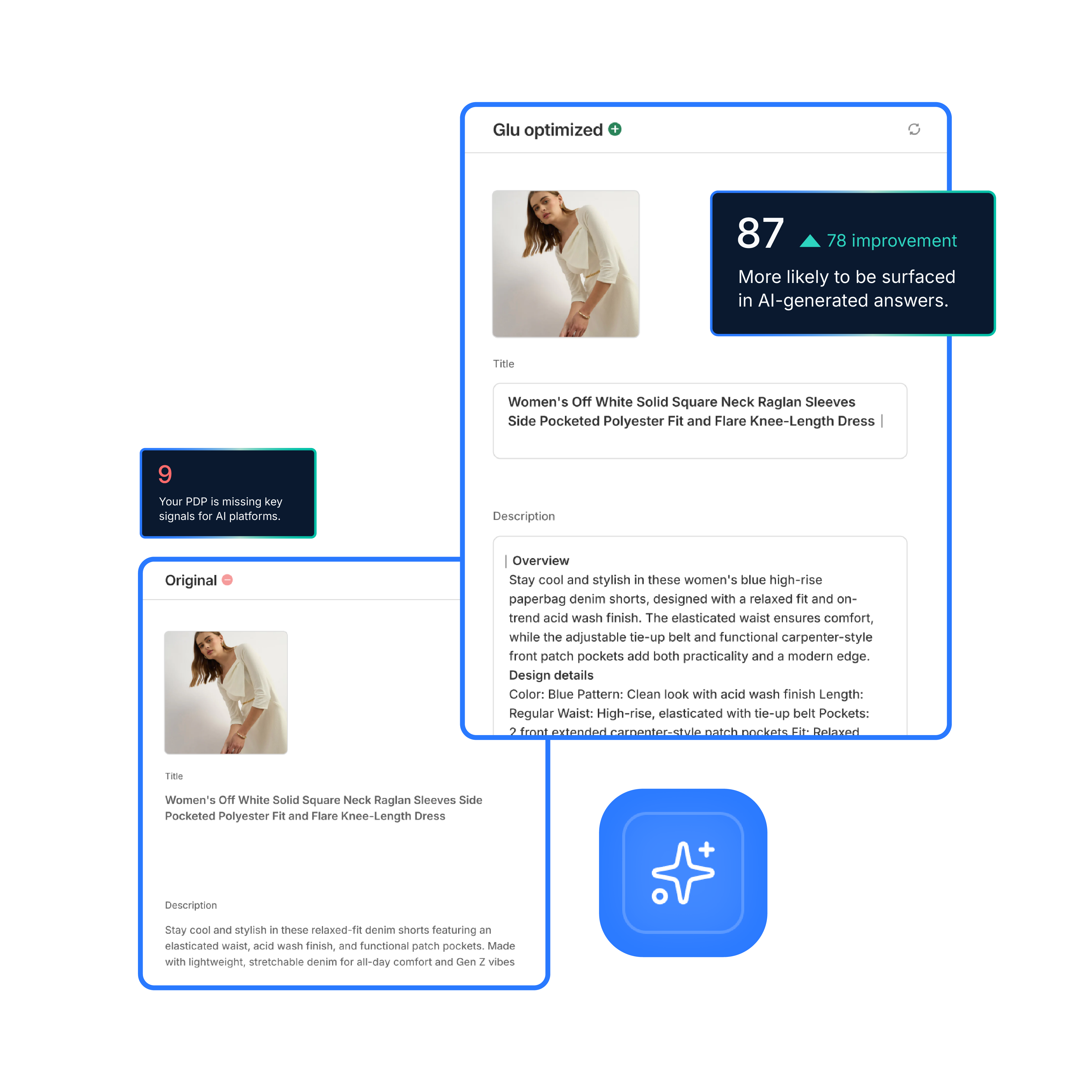
Audit, prioritize and optimize product information across hundreds or thousands of PDPs, so your catalog becomes easier for AI to read, understand and recommend.

.svg)
.svg)
.svg)
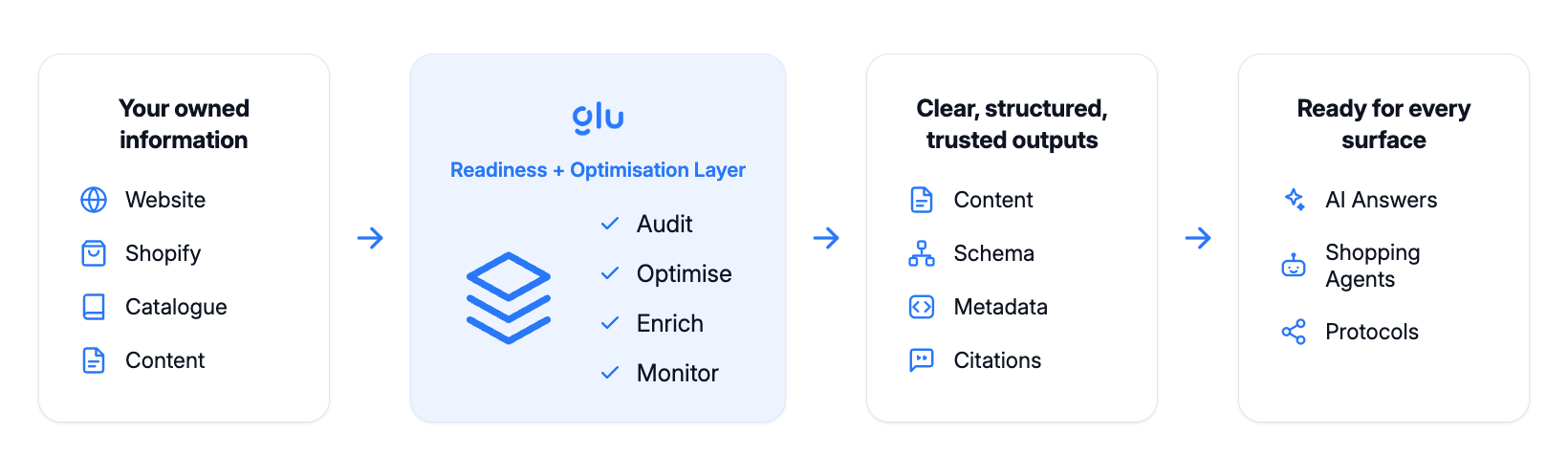
Optimize Once. Prepare for Every AI Surface
Frequently Asked Questions
What's the difference between SEO and AEO
SEO optimizes how search engines index and rank web pages. AEO (Answer Engine Optimization) and GEO (Generative Engine Optimization) optimize how AI systems read, interpret, and represent brands within generated answers. Where SEO improves visibility through links and keywords, AEO focuses on structured data, trust signals, and factual clarity that make your brand usable by AI models. In AEO, the goal is not ranking - it’s representation inside the answer.
What happens with my existing SEO?
It still matters. SEO remains the foundation of how search engines find and index your site. What’s changing is where discovery happens and how results are composed. Your existing SEO work gives AI systems valuable signals - content quality, backlinks, and authority but AI also needs structured context to interpret that information correctly. Glu builds on top of your SEO by making your brand machine-readable and trustworthy in AI-driven discovery. You don’t lose what you’ve done - you extend it into the next phase of search.
How is Glu different from other AEO tools?
Most AEO and GEO platforms monitor visibility or optimize content externally. We operate natively inside Shopify, where brand and product data originate.We identify gaps in how AI systems read your data, optimizes structure and schema, enriches weak or missing fields, and writes improvements back into Shopify. A human-in-the-loop workflow ensures that every update maintains factual accuracy and brand integrity.The result is an AI-ready commerce layer- continuously improving how engines like ChatGPT, Gemini, and Perplexity interpret, trust, and surface your brand.
How fast will I see results
Initial results are visible within 6 - 8 weeks, depending on your current data structure and content consistency. Once integrated, we restructure your store data, validate schema markup, and improve metadata for AI comprehension. As AI crawlers and retrieval engines update, your brand begins to appear more accurately and more frequently in relevant generative responses.
How frequently do you monitor AI platforms, and how reliable is the data?
Glu runs daily prompts across major AI platforms, capturing and parsing every response to understand how each system represents and evaluates a brand. We track real user experiences, capturing precisely what users see, including platform‑specific features, optimizations, and variations. Increasing prompt volume, for example - running 100 versus 50 prompts per day improves accuracy by reducing variance and giving us a clearer signal. Over time, the aggregated trends and averages across these responses become stable, reliable, and actionable for optimization.
What would happen if I consider GEO at a later stage?
Nothing breaks — but visibility becomes harder to recover later. AI systems learn continuously, and early structure gives your brand a head start in how it’s read, trusted, and represented. If your data isn’t optimized now, AI may build incomplete or inaccurate associations that take longer to correct. Starting early means your brand grows with the new discovery ecosystem instead of playing catch-up once competitors are already trained into it.
.svg)
Own the Answer. Lead the Next Era of Commerce.
.svg)
.svg)
.svg)
.svg)