

A few years ago, the path to purchase was a marathon. A customer searching “best running shoes for flat feet” would open ten browser tabs, spend an hour comparing options, reading blog reviews, and carefully vetting brands.
Today, that marathon has become a sprint.
Now, customer simply asks their AI assistant (ChatGPT, Perplexity, or Google’s AIOverviews): “What running shoes work for flat feet and knee pain, under $150, and in stock near me?” In seconds, they get three targeted recommendations, clear reasoning why each is best, and direct links to buy.
The entire middle of the traditional purchase journey, the part where customers browse websites, compare options, and narrow down choices, is being automated away.
This fundamental shift is exactly why Generative Engine Optimization (GEO)has become essential.
GEO in one sentence: Generative Engine Optimization means structuring your brand’s digitalDNA, your products, facts, and expert credentials, so AI tools can deeply understand, cite and recommend you.
While traditional SEO was about competing for a spot in a list of ten blue links, GEO is about becoming the recommended answer inside AI conversations.
Here’s how GEO differs from SEO?
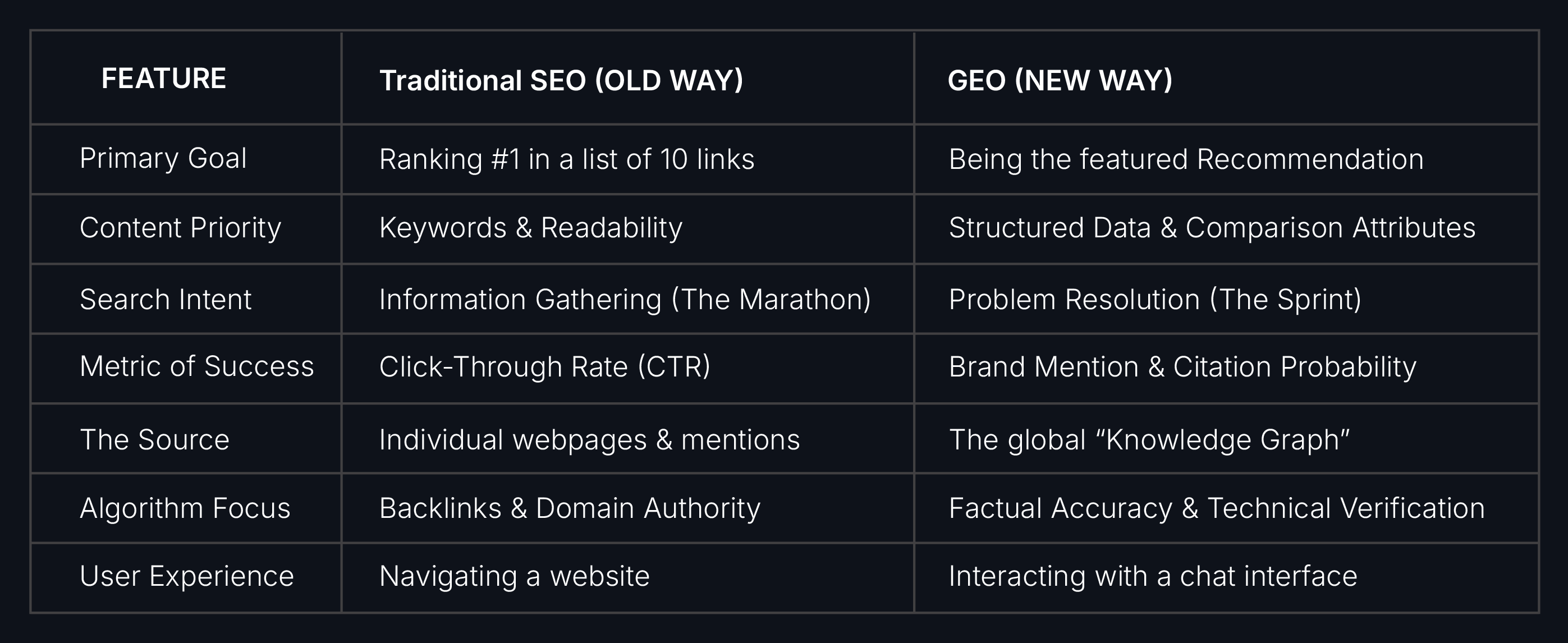
In the marathon era, clever keywords and backlinks could carry you far. In the 2026 sprint, AI engines have become the new gatekeepers, and they are ruthlessly discerning.
Because Large Language Models are prone to hallucinations, they tend to prioritize sources they can instantly verify. If an AI cannot quickly confirm your claims with clear, consistent evidence across the web, it will simply ignore you in favor of a competitor it trusts more.
To be recommended, AI systems need to see a strong consensus that your brand is credible, active, and authoritative in its category. Without those trust signals, you’re not even in the race.
Here’s how forward-thinking brands are making themselves legible, credible, and chosen byAI:
1. Prioritize the Footnote (Technical Trust) In 2026, the real battle is for the citation. Use proper Schema markup to clearly label prices, reviews, availability, and product attributes. When anAI can reliably footnote your site as the verified source of a fact, you win the click and the sale.
2. Focus onSpecific Attributes (Comparative Data) Vague claims like “great coffee” or “comfortable shoes” are no longer enough. Instead, provide precise, comparable details: “Low-acid, shade-grown, fair-trade organic coffee from Ethiopia” or “Running shoes with 8mm drop, wide toe box, and certified arch support for flat feet.” The more specific datapoints you offer, the easier it becomes for AI to compare you favorably against competitors.
3. BuildConsistent Authority Signals (Social Trust) Ensure your brand facts align perfectly across your website, LinkedIn, industry directories, and news mentions. AI systems look for consensus. Any contradiction between your About page and your founder’s LinkedIn profile creates confusion and lowers your trust score dramatically.
While platforms like Shopify are improving, the real challenge lies in how clearly and completely your product data and brand context are structured for machine interpretation.
This is where Glu.ai comes in.
Glu.ai works at the critical layer most brands overlook. It analyzes what AI currently cannot clearly understand about your products and automatically restructures your data for maximum machine readability — so your brand isn’t just visible, but actively chosen.
The middle of the sales funnel hasn’t disappeared; it has simply been automated by AI. If you’re still only optimizing for traditional search engines while ignoring how customers actually discover and decide in 2026, you’re leaving revenue to chance.
When your next customer asks their AI assistant for a solution, will your brand own the answer?
Explore theGlu.ai app on Shopify and start optimizing for free today.